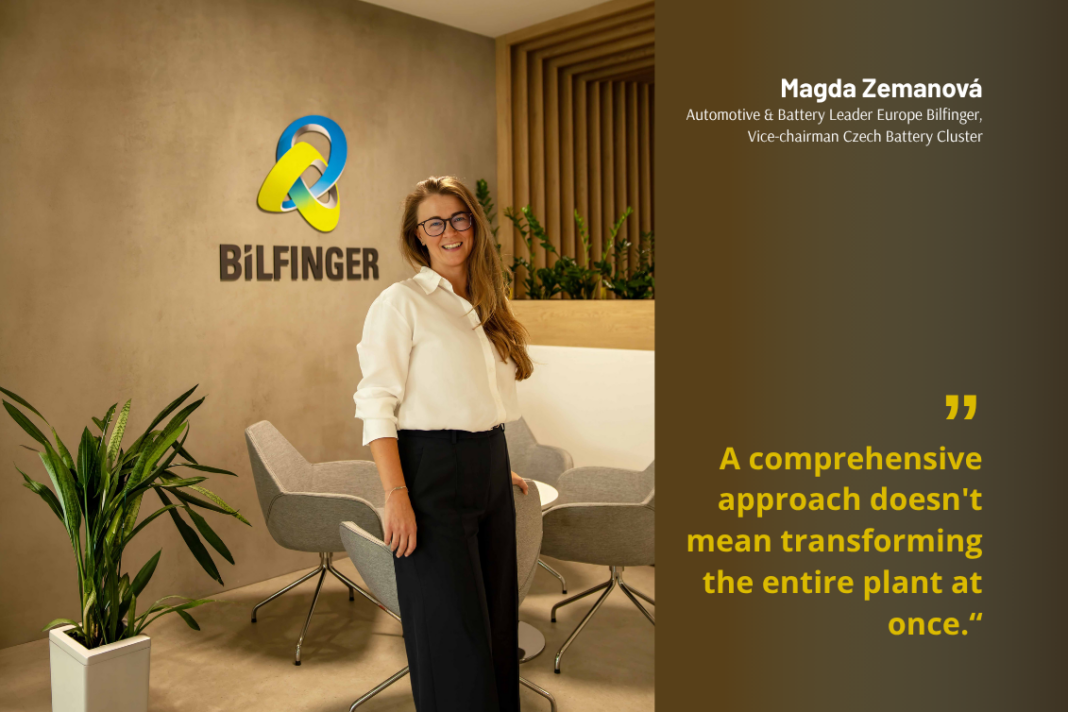
From project management through to sales, and on to the automotive and battery industries. During her time at Bilfinger, Magda Zemanová gradually moved from project management to the development of markets and industrial segments in Central and Eastern Europe. For her, the battery industry marked an entry into a new technological field that is developing rapidly and bringing new demands not only on production itself, but also on the design of manufacturing plants. One word came up repeatedly in our interview: complexity.
Car manufacturers today are grappling with the transformation of individual plants, investment uncertainty, energy, data, new technologies and a shortage of skilled workers. According to Magda Zemanová, a comprehensive approach does not mean changing the entire plant all at once. It means first assessing it as a whole, drawing up a long-term plan, and only then gradually deciding on individual investments.
Your career path at Bilfinger didn’t start in sales or with batteries. How did you actually end up specialising in the automotive and battery industries as you do today?
I originally worked as a project manager. I actually got into sales rather by chance, when a colleague was leaving and, out of all the project managers, I was probably the best-suited person to take on the role. At first, I imagined sales to be traditional selling, which didn’t really appeal to me.
Gradually, however, I realised that sales at Bilfinger is something completely different. It’s primarily about developing relationships with customers, markets and individual industrial sectors. You also get involved in broader areas, such as economic or government missions abroad. And I began to really enjoy that.
My role gradually expanded to cover Central and Eastern Europe, and within Bilfinger I began to focus on the automotive sector. The battery industry then came into the picture quite naturally, as it’s closely linked to mobility and the transformation of the automotive sector.
Were batteries a completely new world for you at the time?
Yes, and that’s precisely what made it so interesting for me. I had to learn a lot of new things: what a gigafactory is, how the individual parts of a battery work, what the entire production process actually looks like, but also the supply chain – ‘who’s in bed with whom’ – and where the so-called bottlenecks are. Whether from the perspective of raw materials, logistics costs, intellectual property or scaling, which also became a huge topic.
It was a new technological field for me, one I had to immerse myself in. Thanks to this, I gradually came into contact with many organisations focused on the battery industry and subsequently joined the Czech Battery Cluster on behalf of Bilfinger.
The automotive industry is currently undergoing a fundamental transformation. What do you think is having the greatest impact on the production plants themselves?
It’s a combination of technological transformation, pressure on costs and energy, along with a growing need for flexibility. Added to this are carbon footprint reporting, related reporting requirements and the drive for the most sustainable production possible. Some of these factors can even work against one another.
The automotive sector has always been changing. Models have changed, and assembly lines have been adapted accordingly. However, electromobility brings about a more significant change. If you look at a conventional car and an electric car, the entire product is changing. In a combustion-engine car, you have an engine, a gearbox and other components which, in an electric car, are either absent altogether or are different.
At the same time, a car manufacturing plant is divided into individual production areas, known as ‘shops’. And with the advent of electromobility, some of these are falling into disuse. Car manufacturers are, of course, trying to continue using the existing facilities, as they are still operating the plant and need to utilise them in some way. However, modernising an older plant naturally involves more constraints than building a new one to current standards.
This is precisely where the question arises as to what a car manufacturer should actually invest in.
Yes, and that is a major source of uncertainty. Car manufacturers today do not have an easy decision to make. They must decide which operations to retain, where to transform them, or where to demolish something and rebuild it differently. For decades, they had a certain degree of certainty in this regard. They competed with one another, but car sales kept rising and their investments had a relatively clear direction. Today the situation is different, and making a decision on any major investment is truly crucial for them.
In such a situation, is it easier to build a new plant or to modernise an existing one?
Each has its merits. A greenfield site has the advantage that you can start from scratch and build a truly ‘state-of-the-art’ plant. You face fewer constraints and can consider, right from the outset, how the various systems will work together. With older plants, it’s more complicated. The automotive sector is at a disadvantage in this respect, as many factories are really quite old, and turning such buildings into a ‘factory of the future’ is no easy task. You come up against existing structures, utility networks, layout constraints, fire safety regulations, the capacity of the energy infrastructure, and the fact that you often cannot simply shut down the plant and must carry out modernisation whilst it’s still in operation. It therefore requires very good, long-term planning. And sometimes you find that certain changes aren’t even feasible or simply don’t make sense.
So does modernisation have to be done all at once, or can the company proceed step by step?
It can certainly be carried out gradually. In my view, complexity does not mean changing the entire plant all at once. It means assessing it as a whole at the outset and being clear about where you want to end up. The basis is a long-term plan, a sort of ‘plant development roadmap’. It shouldn’t just be a table of investments, but a process that takes interdependencies into account: when it makes sense to address energy issues, what must precede automation, how automation will develop further, how maintenance requirements will change, or where new demands for water, steam, cooling, ventilation or skilled staff will arise.
The preparation should also include a thorough assessment of risks that may arise in the future. Without a holistic view, a single well-intentioned measure may later complicate operations or reduce their efficiency. And this is where the way the company is managed plays a major role. It is important to have people on the team who do not just look ahead to the next year, but who are responsible for longer-term development, looking as far ahead as ten or fifteen years. 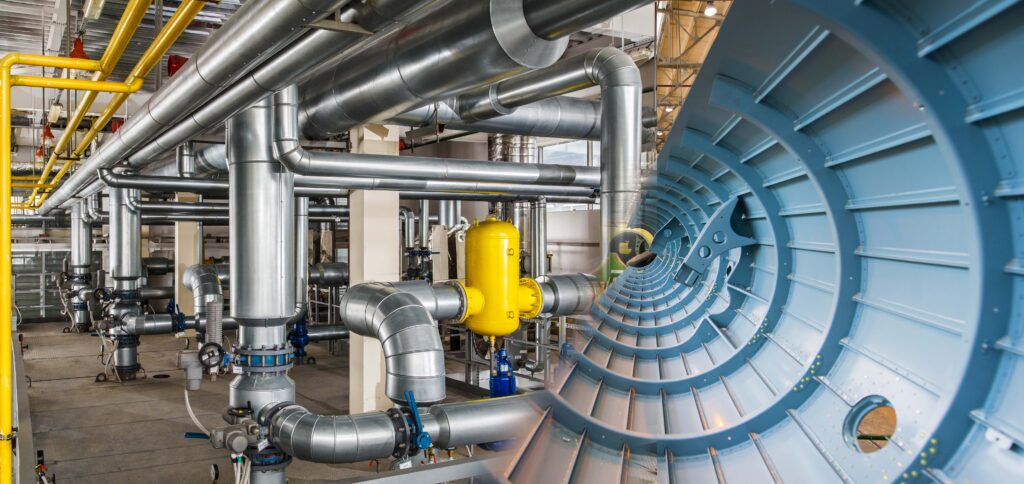
A long-term plan should not merely be a table of investments.
Energy efficiency has become one of the industry’s key issues. Where do you think the greatest potential for savings lies?
There are many possibilities. The key, however, is to really know your plant. Once you have a clear picture of your operations, you can pinpoint exactly where heat or steam is escaping, where losses occur, what can be reused and, above all, which measures make economic sense.
It is important to monitor consumption on an ongoing basis and to link production parameters with energy data. It is not enough to know how much electricity or gas the plant has consumed in a month. What matters is understanding which production line, shift, product or operating mode is actually driving that consumption. Only then can you reliably assess the real return on individual investments.
The problem today is not so much obtaining the data, but actually making use of it, is it?
Exactly. Obtaining data isn’t really such a problem these days. What’s important is knowing how to make proper use of it. If you have your own energy source, such as renewable energy, monitor electricity price trends and perhaps have battery storage, you can work with that data much more effectively. But you need someone who understands it and can link it all together properly. If, for example, you have a solar panel system, weather forecasts also come into play. Based on these, you know how much electricity you’re likely to generate, and you can plan its use accordingly. Here, everything really has to work together like an orchestra.
At the same time, relatively simple measures can sometimes yield significant savings.
Definitely. Fortunately, in my view, heat recovery and the utilisation of waste heat are already largely standard practice. They were among the first steps that factories implemented during the wave of energy-saving measures. One reason is the return on investment, and also the fact that these measures are usually relatively easy to implement, although it does, of course, depend on the specific operation.
Sometimes the solution can be really simple. One example is Bilfinger TIPCHECK (Technical Insulation Performance Check), which identifies potential energy savings in industrial operations through an analysis of insulation. Put simply, the inspection involves checking the pipework, identifying areas of heat loss and proposing suitable measures. The savings can be truly significant. To give just one example: the refurbishment of 800 metres of insulation resulted in energy savings of 49 per cent and a payback period of three years. Furthermore, energy savings reduce the carbon footprint and can also improve operational safety as an added benefit.
320 MWh of energy savings per year
€42,540 in cost savings per year
49 per cent energy savings
3-year payback period
However, in your view, energy efficiency is not just a matter of the production technology itself.
It isn’t. Given the complexity of production processes, optimising the building and infrastructure aspects of a plant can also make a significant difference. This might involve insulating the building envelope, replacing windows, adjusting lighting or heating systems, installing sensors or fitting shading to skylights. Even if, for example, you do not wish to have your buildings certified to LEED or BREEAM standards, it is a good idea to adopt some of the best practices that are very often applied in these certification schemes.
It is also important to look at the wider picture, such as on-site logistics, the management of packaging materials, or the integration of greenery. It is precisely here that we can see how energy management, sustainability and operational efficiency influence one another. The biggest mistake is to deal with energy, technology and construction in isolation. And that is precisely why, at Bilfinger, we strive to support our clients right from the initial planning stages, from strategy right through to specific implementation projects. All within the right context.
So even switching from gas to electricity isn’t necessarily the right decision?
Exactly. I’ve also come across cases where corporate strategy dictates a switch from gas to electricity, but this may not be the optimal solution in individual countries. Nevertheless, the change goes ahead because it’s part of the company’s global or regional strategy.
On the other hand, fortunately, we see that the more enlightened companies have their main strategies set out more as a guide, but then have individual measures ‘approved’ locally, whether by their operational teams or by a consultant. The consultant can, for example, add a forecast of future developments, whether economic or technological.
Unfortunately, the greatest uncertainty remains geopolitical developments, which can have a significant impact on energy prices and the availability of technologies.
Does a comprehensive approach also mean that the same solution may not work in two different plants?
Definitely. Many factors come into play in the design and modernisation process. These include the plant’s location, the local supply chain, the availability of raw materials, as well as other partners and resources in the vicinity.
I like a pragmatic approach, and that applies doubly here. You need to think not only about the materials you use and whether they can subsequently be recycled, or how you manage energy and natural resources, but also about what’s around you and what can be utilised.
That is why it is always necessary to carry out a comprehensive assessment of a specific plant, including all its impacts and interdependencies. This is sometimes overlooked when corporations seek to apply standardised solutions across multiple countries.
The same measure may work excellently in one plant, but elsewhere it may run into issues such as energy costs, the availability of utilities, staff qualifications, space constraints or the local permitting process. Standardisation makes sense as a framework, but the final decision must also stand up to the specific conditions on the ground.

Every investment must make sense for the specific plant in question.
A significant part of your work involves the battery industry. How do battery projects differ from those we are familiar with in traditional car manufacturing?
One of the major differences is the speed of technological development. In the automotive sector, too, products, production processes and prototypes change, but with battery projects we’ve found that frequent technological changes occurred during the project itself, and the construction work had to adapt to them. And this happened several times in succession. By the time construction was completed, there had been a great many such changes.
It goes without saying what impact this had on investment costs. That is why, when building such a plant today, you need to plan the most flexible layout possible right from the start. You know, after all, that it will change in the future. And in battery projects, the need for flexibility is particularly pronounced.
But battery production also has specific requirements regarding the plant environment itself.
Yes. A great deal depends on which part of the battery supply chain is involved. Terms such as ‘battery production’ or ‘battery factory’ are used very frequently, but they can be misleading.
The production of cells in a gigafactory is one thing; the upstream part of the supply chain – that is, the extraction and processing of raw materials and the production of components, primarily cathode and anode mixtures, electrolyte and separators – is another; and the assembly of modules or battery packs is yet another. Each of these stages has different technical and operational requirements.
Production across the battery supply chain typically has specific requirements regarding environmental cleanliness and humidity. This places different demands on the technical building services and, once again, on energy consumption. Most of these projects are therefore relatively energy-intensive. Another key issue is water: the management of process water and the drive to maximise its circularity.
• A flexible layout
• Energy infrastructure
• Process water and circularity
• New technical professions
Is the battery industry also changing the requirements for the staff that plants need?
Absolutely. It’s similar to a trend seen across almost all sectors – put simply, fewer manual roles and more engineering roles. It also depends on whether you have research and development at the plant. This is generally regarded as adding significant value to the plant. In the case of a battery project, whether it’s a gigafactory or upstream production, you mainly need chemists, electrical engineers, mechanical engineers and process engineers.
In your view, electrification isn’t just about cars.
Exactly. Electrification cuts across practically everything. You’ve got batteries in mobile phones, cameras, forklift trucks, saws, lawnmowers, drones and a whole range of other devices.
We’re also seeing a huge boom in battery energy storage systems. I’ve noticed this among battery manufacturers too. Some originally set out to produce mainly cells for cars and are gradually shifting their focus to BESS (Battery Energy Storage Systems) as well.
Meanwhile, electricity consumption will continue to rise. This is driven not only by electrification and car charging, but also by factors such as climate change and the associated increasing use of air conditioning. This, in turn, creates new demands on the energy infrastructure.
The maintenance of industrial facilities is also a key issue. How are customer requirements regarding operational reliability and predictive maintenance changing?
Today, customers expect maintenance to deliver not just the repair of faults, but above all greater operational reliability, fewer unplanned downtimes, safety and cost control. That is why maintenance is shifting towards a data-driven approach. For example, vibrations, temperatures, energy consumption and equipment operating parameters are monitored.
The aim of predictive maintenance is to identify a problem before it causes a shutdown and to schedule servicing at the right time, for example based on trends in motor vibrations, a rise in bearing temperature or unusual energy consumption. However, simply collecting data is not enough. It is important to interpret it correctly and link it to technical knowledge of the specific equipment and its operation.
Bilfinger’s strength in this regard lies in its combination of technical knowledge of the equipment, engineering expertise and experience in operational maintenance. Predictive maintenance is therefore not just about data, but above all about the ability to distinguish between what is a normal variation and what may be a sign of a future fault.
And what about artificial intelligence? Is it already becoming a standard part of industrial projects, or is it still mainly limited to individual pilot implementations?
I’d say we’re somewhere in between. In administration, document management and data analysis, artificial intelligence is already used quite commonly. In industrial operations themselves, however, its deployment is more cautious and often depends on the quality of available data, the readiness of systems and cyber security.
AI has great potential, particularly where it helps to handle large volumes of data, identify patterns and support expert decision-making – for example, in predictive maintenance, optimising energy consumption, planning service interventions or identifying abnormal equipment behaviour. However, practical benefits only arise when the data is of high quality, correctly structured and linked to real-world operational knowledge.
At the same time, AI outputs must always be checked by a person who understands the subject matter. It is therefore not a question of AI replacing experienced experts, but of helping them to process information more quickly and identify patterns. In industry, it is not just about the speed at which data is processed, but also about safety, reliability and accountability for the outcome.
At the same time, automation is changing the demands placed on people. Does a modern factory need a different type of employee than before?
Definitely. Some roles in manufacturing are disappearing, but at the same time, new ones are emerging. The more advanced the technologies, maintenance and operational management become, the more you need people who are capable of managing and understanding these systems. Traditional mechanical skills alone are no longer enough, as discussed in the previous topic. You need people who can bridge these worlds, and such specialists are not easy to find.
We have high-quality technical universities, and they produce very capable graduates. I see the problem more in the speed with which we can respond to the emergence of new fields of study and the demands of industry. At the same time, we must persuade young people to want to study these subjects in the first place.
In your view, which technologies or areas will have the greatest impact on the competitiveness of manufacturing companies in the coming years?
Definitely the pace of innovation, the ability to adapt, and long-term planning with alternative scenarios. It is not enough simply to predict market developments; it is also necessary to comprehensively assess the risks associated with them.
In my view, it won’t be about one specific technology or a single ‘right’ investment direction. Companies will have to think much more in terms of the bigger picture: what makes sense to modernise, what needs replacing, where automation will help, how to manage energy or data, and what all this will mean for people and operations themselves.
In my view, those who can adapt to change, whilst not basing their decisions solely on current trends, will have the advantage. Every investment must make sense for a specific plant.