When you first visit a production plant that wants to reduce its energy costs,what is the first thing you look for? How can you tell within a few hours whether the company has its energy management under control?
The first thing I’m interested in,of course,is whether they’ve switched the coffee machine to energy-saving mode (he laughs). But seriously. The first thing my colleagues and I look at is how energy actually flows through the plant,both over time and across the site. Where it’s generated,where it’s transformed,where it’s consumed and where it’s lost. It’s not just about electricity,but also gas,steam,heating and cooling water,and compressed air.
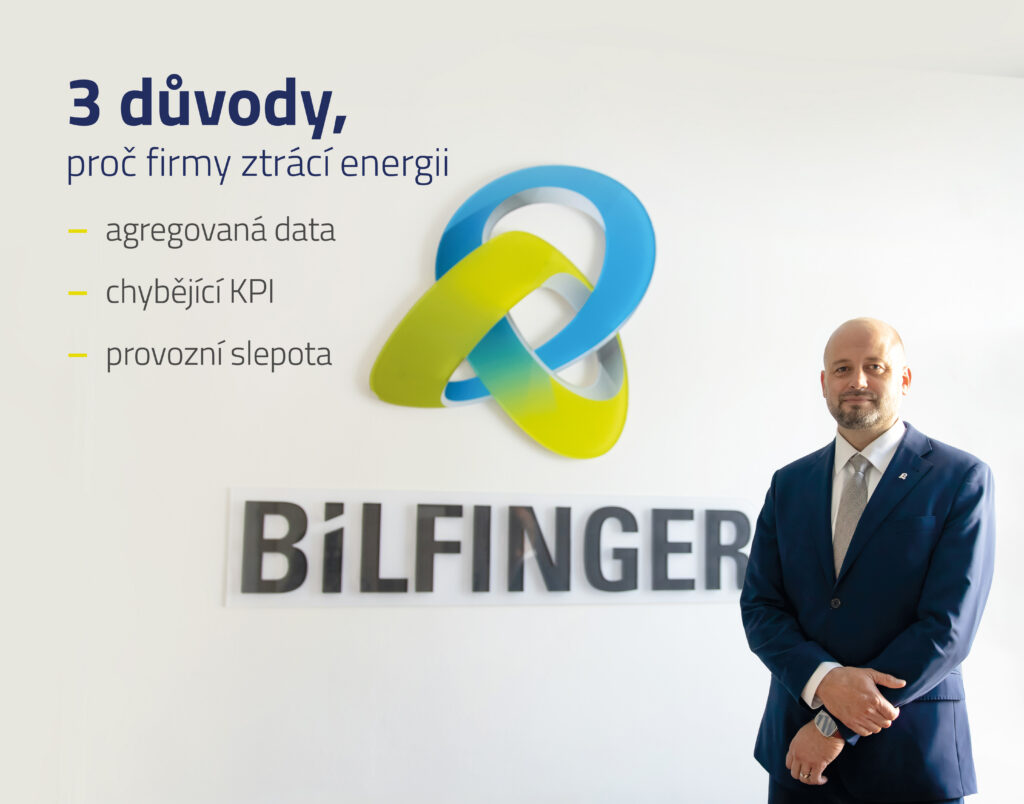
Data quality is absolutely crucial. Only once you know what is actually happening in operations does it make sense to assess the age of the technology or plan investments. In practice,you can very quickly gauge the standard of management by whether a company has detailed consumption measurements across its operations,or whether it works solely with aggregated bills and treats energy costs merely as a single figure within OPEX – simply as an expense. In many companies,energy is still viewed merely as part of operating costs. In reality,it should be managed just as systematically as production itself.
I also work with international clients,both from the CEE region and from highly developed markets such as Finland. From an international perspective,it is clear that advanced plants have detailed metering,known as sub-metering,which covers 70 to 90 % of consumption. The discrepancy between planned and actual consumption there is less than 5 %. Less advanced facilities typically show discrepancies of 20 to 30 %,without knowing exactly why. It is precisely here that there is often scope for savings. It is not uncommon for a company to be able to reduce consumption by 10 to 15 % without major investment,simply by starting to manage its energy use effectively. Energy management must operate in the same way as production. It requires clearly defined KPIs,accountability among specific individuals,and regular evaluation of results.
“Energy management must be managed just as systematically as production.”
Pavel Celunda
What are the most common mistakes in energy management that you find in Czech manufacturing companies today? Is it more often a case of outdated technology,or rather poorly configured processes
and operational habits?
Czech industry is doing surprisingly well in terms of production technologies. Many plants operate with very modern equipment and often achieve an above-average technical standard. The problem usually does not lie with the machines themselves. More often than not,I find that companies lack systematic energy management. Firms invest in new equipment,but they do not have a process in place to optimise their operations in the long term.
Put simply,there’s a certain preconception here:companies think that because they’ve been running the factory for a long time,they know exactly how to do it. Whilst this is true in terms of their product and the production process itself,it blinds them to the bigger picture,and they are reluctant to take a bird’s-eye view of the process. Czech companies still rely heavily on the skill of Czech workers and their long-standing experience. This is,of course,a great advantage,but experience alone cannot replace a system. Energy efficiency must be an integral part of production management,where energy flow must be incorporated as one of the key parameters and constantly optimised. Fragmented responsibility is also a major problem. Energy management is often handled partly by maintenance,partly by production and partly by facility management. The result is that,in reality,nobody manages it as a single,integrated whole.
The problem usually does not lie with the machines themselves. More often than not,companies lack systematic energy management and clearly defined responsibilities.
You say that Czech manufacturing companies are often very well equipped with modern technologies. Yet,in your view,the biggest problem is not usually the machinery,but the people and their approach. Do you come across what is known as ‘operational blindness’ in industrial companies? How difficult is it to convince internal teams that a system which has been running for ten or twenty years can be set up more efficiently?
Yes,very often. I would almost say that the question today is not so much whether we encounter operational blindness,but rather how to overcome it. Operational blindness means that whilst the system works,nobody stops to consider whether it is actually working efficiently,and they question any possibility of optimisation. People are used to it,and any change is perceived more as a risk than as an opportunity. Change is therefore not merely technical,but rather managerial and,above all,cultural. In the Czech context,a traditional resistance to change is still evident. However,if there is a willingness on the part of the company’s management or one of the responsible managers,this attitude can be overcome.
That is why we do not try to walk into a company and say that everything is being done wrong. We usually start with a technical energy study. First,we carry out a simulation and calculate what the theoretical energy consumption of operations should be,and then we compare this with the actual situation. Every factory has a theoretical consumption figure,which you simulate on paper,just as you learn at university. Of course,we know that achieving the theoretical minimum is often impossible or very costly. However,the aim is not to achieve the ideal figure. The aim is to open up a professional discussion and show that there is room for improvement. This gives us points to discuss with the client:Why do you actually need to run this technology 24 hours a day when you have batch production rather than continuous production? Or,conversely,why can’t you run it continuously when you start it up every morning and consume an enormous amount of energy? It is precisely thanks to this that we often manage to identify a number of savings that do not require major investment,but which have simply not been implemented due to ingrained practices or organisational barriers.
You mentioned that the best companies implement up to 80 % of the proposed measures,whilst the average is only 20 to 30 %. In your view,what determines whether one company actually implements changes whilst another stops at the study stage?
The decisive factor is,above all,management’s long-term vision and,of course,the ability to see adopted and planned measures through to the end. The difference between a top-performing and an average plant usually does not lie in the technology. It lies in how the company’s management approaches change management. An energy study alone will not solve anything. It is important that the recommendations are actually incorporated into day-to-day operations and that their results are continuously evaluated. The best companies have a clear vision of where they want to go and are able to systematically implement most of the proposed measures. Average companies often stop at the analysis stage and never get round to the actual implementation.
Can you give a specific real-life example where a seemingly minor change resulted in significant energy savings for a company?
There are plenty of such cases. Sometimes it’s enough simply to reduce the compressed air pressure;at other times,to adjust the heating water temperature where operational conditions allow. No investment is required – just the correct system settings. Of course,every industrial plant is different,and every sector has its own specific challenges. Very often,however,we come across issues relating to thermal insulation and,more generally,the distribution of heat throughout the plant. This is a typical example of operational blindness and the use of aggregated data.
Heat losses tend to be hidden within the total heat consumption and are not monitored separately. Yet it is precisely these losses,caused by unsuitable or damaged insulation on equipment and pipework,that can account for tens of % of the total energy consumption of operations. By optimising insulation,carrying out regular maintenance and improving the settings of operating modes,savings of around 20 % – and in some cases more than 30 % – can be achieved through economically viable measures. And once again,many of these measures do not require substantial investment,just better management.
If we set you the task of reducing the energy consumption of a medium-sized manufacturing plant by 20 %,where would you start?
In my view,a 20 % saving is achievable wherever energy management has not been systematically addressed for some time. The approach is always systematic and multifaceted. First,it is necessary to understand where energy actually flows within the business. I would map out the main energy flows,operating modes and the tariff structure.
Only then do we look for quick measures that do not require major investment. These may include optimising technology settings,rectifying leaks or improving the management of equipment’s standby modes when it is not in use. The next step is to ensure control and regulation:adding measurement capabilities and simple automation. It is precisely thanks to these that the business gains higher-quality data and the ability to utilise it in the future. Only when you know what is actually happening in your operations does it make sense to consider larger investment measures based on hard data,whether this involves new technology or energy sources,the modernisation of compressors,pumps or lighting,or heat recovery. Data first. Investment second.
The utilisation of waste heat has been a major topic in recent years. In your view,how much potential does the Czech industry still have in this area?
The potential remains considerable,and waste heat is a major trend today. Rising energy prices mean that many projects focused on utilising waste heat are now economically very attractive,and their return on investment is significantly better than it was a few years ago. However,the technology is not usually the obstacle. That already exists today. The main problem tends to be,once again,a lack of data and organisational barriers.
Companies often do not know exactly how much waste heat they have available or where it is generated,and they lack a clear plan for its effective utilisation,so they are naturally wary of investing. However,if a company has high-quality data and a well-prepared project,such solutions can yield very promising results.
There is also increasing talk of battery storage systems. In your view,when do they make real economic sense for an industrial company?
Every production manager I have met is well aware of how important storage tanks,buffers or warehouses are for production. It is a fundamental prerequisite for continuous and efficient operation. From this perspective,batteries or other types of energy storage should always be desirable. Integrating them into the power distribution network makes it possible to stabilise consumption,optimise peak loads or utilise surplus energy. It’s a brilliant technology that frees up the plant engineer to explore various energy-efficient solutions.
When companies face the practical problem of being unable to reschedule a shift due to staff – staff protest at having to come in an hour earlier just because energy is cheaper at that moment – they can install batteries,store the cheap energy and then use it when demand peaks. However,it is important to note that batteries alone will not resolve poor processes or missing data. If a business does not have properly configured processes and well-managed energy systems,battery storage will not be a miracle solution. It is a very important component of modern energy management,but always only one part of the whole system.
European legislation is placing ever greater emphasis on ESG reporting and the requirements arising from the CSRD Directive. Does this pressure help companies to manage their energy data more effectively,or does the perception of an administrative burden still prevail?
It is true that the pressure from European legislation has two distinct effects. On the one hand,companies perceive ESG and the associated reporting as an administrative burden and a complex set of methodologies. That is why we at Bilfinger highlight and explain to our clients the positive side of focusing on ESG issues – namely,operational optimisation,cost savings and modernisation.
I believe that the very approach to ESG is gradually changing and moving in a better direction. In recent years,some requirements have been simplified,reporting has been reduced,and greater emphasis is being placed on actual implementation. ESG compels companies to collect high-quality data and manage consumption systematically. The key is to have structured,high-quality data that enables companies to plan investments and track actual savings. Companies that learn to work with data will very quickly move from mandatory reporting to managing the performance of the entire organisation.
Looking ahead,what do you think the role of a corporate energy manager will look like in 2035?
It will certainly be a very dynamic role. Energy managers will work more with data,algorithms and predictive models. Even today,a significant proportion of investment in the energy sector is directed towards digitalisation and management. At the same time,however,the need for in-depth knowledge of technologies will not disappear;it will simply shift to a strategic level.
As I’ve already mentioned,my view is that an energy manager shouldn’t be a standalone role. In industrial plants,there has always been an energy manager,but their role was more that of someone who ensures everything runs smoothly. It is only in the last few decades that they have been able to influence production and shift patterns. Today,energy managers are often viewed within companies as an overhead,as a cost,which is why they do not wield much power. The production director,on the other hand,oversees the operations that actually manufacture products and generate revenue. In my view,energy intensity must be one of the key performance indicators directly for the manager responsible for production. Alongside product quality and quantity,the energy intensity of production will stand as an equally important,highly significant factor.
We have spent most of the interview discussing energy savings within manufacturing companies. How do you view the current state of the Czech energy mix as a whole,from which industry draws its energy?
I feel that these days we often focus on individual technologies,but less on the energy system as a whole. We discuss whether to build a 50 MW power plant somewhere,but in my opinion we need to think on a completely different scale. The Czech Republic needs to address the replacement of gigawatts of capacity,not just tens of megawatts here and there. Everything is changing incredibly quickly and long-term plans are collapsing due to geopolitical factors. In the past,planning in the energy sector was done in decades;today,I’m looking at a horizon of two to three years. That is precisely why investment is difficult for companies,as they lack long-term predictability.
In recent years,politicians have launched the Green Deal and pushed for new technologies,and there was huge investor enthusiasm surrounding it. But then investors came back down to earth – those projects were often not being carried out by stable companies. Looking back,we can see that these start-ups built a massive Gigafactory and then halted the rest of the project,which in turn dragged down the entire supply chain and people’s efforts. So now,in my view,we need to quickly skip the remaining stages – finding someone to blame,punishing the innocent and rewarding those who weren’t involved. The way forward certainly lies in drawing up a long-term plan – stability is sorely lacking in the energy sector today. Yet people will always need to heat their homes,light their homes,charge their mobiles or communicate with AI via data centres,so more and more energy will be needed;that is a given.
What role do you think nuclear energy will play on this gigawatt scale?
I am convinced that the Czech Republic will not meet its long-term targets without nuclear power. In my view,nuclear power represents a stable,zero-emission foundation for the energy mix. Alongside it,of course,renewable sources such as photovoltaics or wind farms have their place. However,these are not sufficient on their own,as they only generate electricity when conditions are right. They need to be supplemented by a stable source and large-scale storage.
The technology for energy storage has,in fact,been around for a long time. As far back as fifteen years ago,we were preparing projects that involved storing energy by compressing air into underground reservoirs,which would then be released through a turbine during periods when electricity prices were high. They were not implemented at the time,but today it is becoming clear that similar solutions may once again be highly relevant. I view the Czech Republic’s decision to proceed with the construction of new nuclear reactors very positively. Such projects create enormous opportunities for Czech industry,supply firms and technical education. I hope that we will succeed in training a new generation of experts through these projects and that we will retain this expertise in the Czech Republic. I would be delighted if,in future,we could rely increasingly on our own know-how,with Czech firms taking on a greater share of the supply chain and responsibility for further projects,and if we could organise the auxiliary operations and engineering (balance of plant) operations ourselves.
Biomass is often cited as one of the pathways to decarbonisation. Yet you are rather sceptical about its wider use. Why is that?
I do not believe that biomass can represent the main solution for the Czech energy sector in the long term;to me,this is completely incomprehensible. New biomass-firing projects are emerging,but at the same time there are studies warning that even the current installed capacity will soon reach the limits of fuel availability on the Czech market. If we continue at the same pace,we’ll have to import a significant proportion from abroad,which makes no sense. Every energy source has its place,but it should form part of a well-thought-out system.
As well as energy efficiency,Bilfinger is also involved in carbon capture projects. Do you feel that carbon capture will play an increasingly important role in industry?
Definitely. We are a large company,and energy efficiency is often the gateway to much larger projects. When we tackle,for example,compressed air or the energy management of a production plant,it opens the door to further investment. As a result,we end up working on projects of a completely different scale. A typical example is precisely Carbon Capture,which you mention. In some sectors,such as the cement industry,we’re no longer talking about studies costing hundreds of thousands or projects worth millions of crowns,but about investments running into the billions. This,too,is part of ESG and decarbonisation,just on a completely different,monumental scale. Such projects then create a whole chain of projects – for example,the utilisation of captured CO₂ – fertilisers,methanol,refrigerants,…
During your career,not only at Bilfinger,you have worked on projects in Europe,America,Russia,Africa and India. What has this international experience taught you?
Every country has taught me something different. I believe that if we really want to understand people,it’s not enough just to exchange emails or talk to each other from a distance. You need to get to know how they live,how they think and what problems they face. Only then can you understand why they do things the way they do. India made a strong impression on me. I was struck by the hard-working nature of the people there and their approach to education. It’s not unusual for a whole family to chip in to fund one member’s studies. There’s a tremendous drive to keep moving forward. I went to Russia straight after university to manage a construction project,so that was a very intense professional experience. America,on the other hand,captivated me with its freedom and approach to business. Each country showed me a different way of working and thinking.
I also believe we shouldn’t underestimate Asia. In a number of areas,such as electric mobility or battery technologies,Asian companies are now technologically far ahead,and Europe has much to learn from them. Nevertheless,I’m glad to be living and working right here. The Czech Republic has a strong industrial tradition,high-quality technical education and an excellent location. We have skilled people and great potential. If we think long-term and are not afraid of change,I believe we have a solid foundation to build on.
Yet you often talk about how we should think more in the long term.
Yes. But when I look at companies from South Korea,China,the United States or other countries with strong investment,I don’t see any fundamental difference in what their people are capable of. They are experts just like ours;they are no superhumans. The difference tends to lie in the fact that they plan for the long term and aren’t afraid to invest transparently in the future. I’m convinced that we have the same expertise here;we just need to give them the opportunity,more scope and keep those people at home.
If,in conclusion,you were to give one piece of advice to directors of manufacturing companies who want to reduce energy costs in the long term and increase their companies’ competitiveness,what would it be?
Start with the data. Not by purchasing new and expensive technologies. If you do not know where energy actually flows within your business and where it is being wasted,no investment will deliver the expected results.
And my second piece of advice is not to be afraid to bring in independent experts to work with you. Not a supplier of a single specific technology – who will,naturally,push their own product – but a partner or consultant who can look at the entire operation in context,compare various options and propose solutions based on the business’s actual needs. Furthermore,if you can find a point of contact within the company who is interested in this,you’re halfway there. Ideally,this shouldn’t be someone dedicated purely to energy management,but someone responsible for the entire production process. Energy efficiency isn’t a one-off project;it’s a long-term approach to managing the business.
Start with the data. Not by purchasing new and expensive technologies.