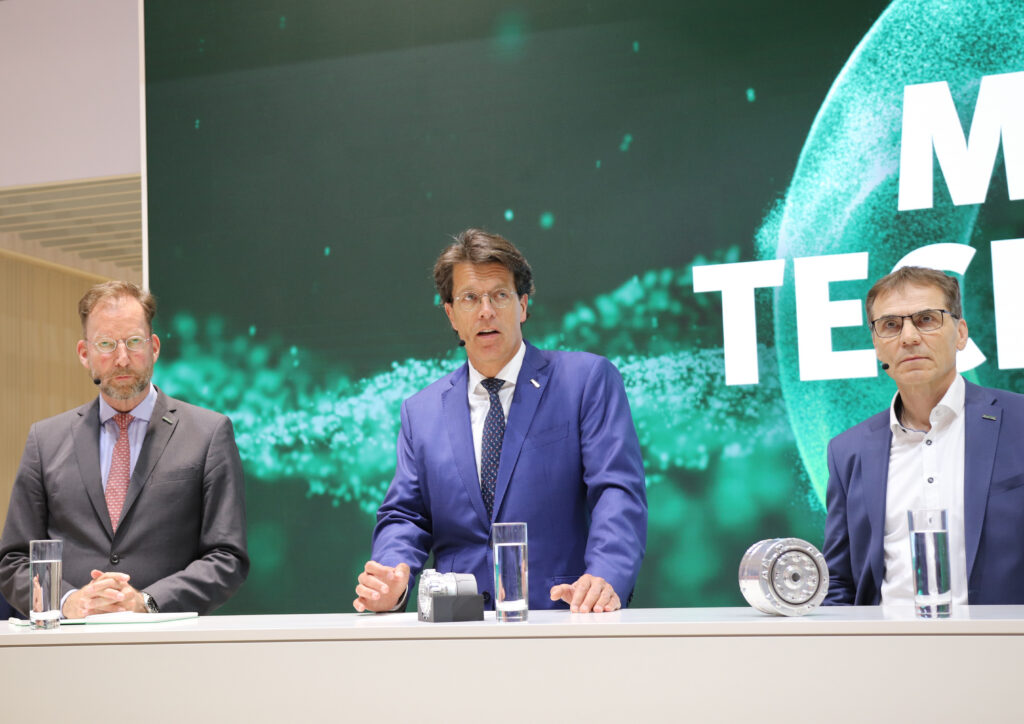
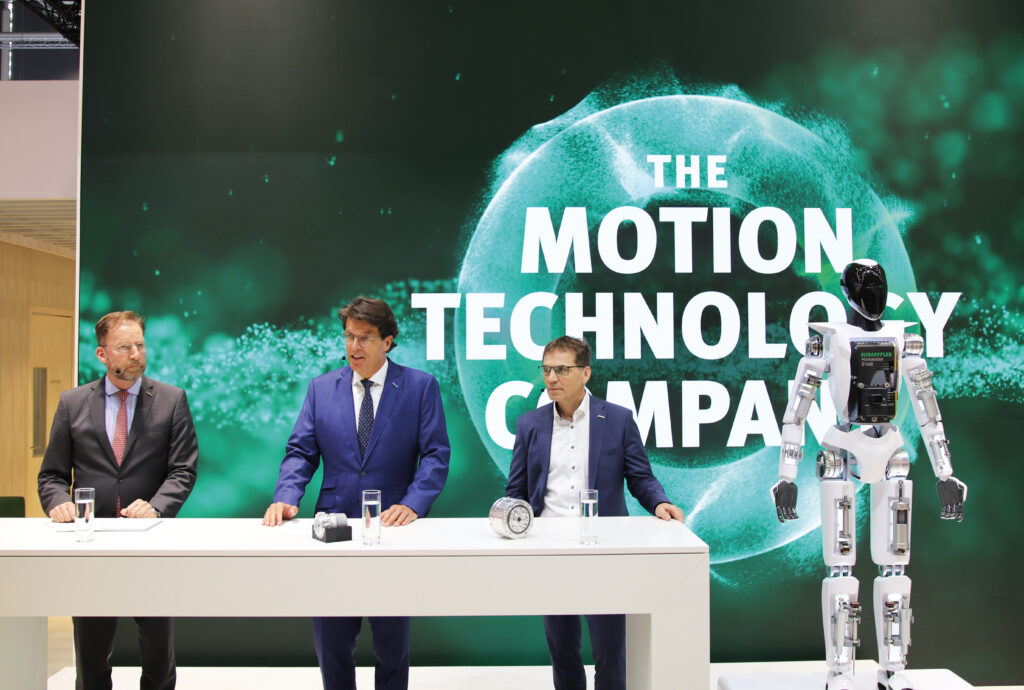
At Hannover Messe, where the latest trends in global industrial development converge every year, it is no easy task to really make an impression. Yet Schaeffler’s stand managed to do just that. It did not merely present isolated products to visitors, but a comprehensive concept that systematically guides them from basic mechanical principles right through to humanoid robotics. The press conference, which formed part of the presentation, set out a clear framework for the brand’s entire transformation. It was not just about unveiling new products, but about explaining the wider transformation of the group into a modern Motion Technology Company.
The transformation of an industrial supplier into a technology leader
In his speech, CEO Klaus Rosenfeld emphasised that Schaeffler is undergoing a fundamental period of change. With a turnover of approximately €24 billion and 110,000 employees worldwide, the company is now positioning itself as a technology partner for comprehensive motion solutions. However, this change is not based on abandoning existing areas of expertise, but on their logical expansion. The foundation remains the ability to manufacture high-precision components in large volumes, a characteristic that has defined the company since its founding in 1946 by the Schaeffler brothers in Herzogenaurach. This year, the company is celebrating its 80th anniversary, which serves as a springboard into the era of artificial intelligence.
This continuity forms the basis for further development. Currently, manufacturing expertise is being complemented by new fields, notably electronics, sensor technology and software. Klaus Rosenfeld noted that it is precisely the combination of these fields that enables the company to respond effectively to trends such as digitalisation, automation and the growing influence of robotics. Schaeffler’s manufacturing excellence now encompasses more than 90 technological fields, including hot and cold forming, machining, heat treatment, plastic injection moulding, surface treatments and additive manufacturing. These manufacturing technologies serve as the technological link that connects all the Group’s regions and business areas.
Artificial intelligence
as a bridge between reality
and the digital world
The next part of the presentation focused on the practical application of artificial intelligence in an industrial context. Schaeffler is one of the first major groups in its sector to have begun promoting the use of AI in various areas of production, logistics and administration. In this regard, the company is building on its collaboration with global leaders such as Microsoft, SAP, Siemens and NVIDIA. In particular, the partnership with NVIDIA, focused on the Omniverse platform, points the way forward for industrial manufacturing. Digital models, simulations and the integration of real and virtual processes make it possible to optimise production even before it is physically implemented. The company received the German Innovation Award in Munich for this innovative approach.
The company’s transformation is also supported by the expansion of its product portfolio to include eight product families. This expansion was significantly bolstered by the acquisition of Vitesco Technologies, which has integrated cutting-edge electronics and sensor technology into the company’s traditional focus on mechanics and mechatronics. This combination opens up new application possibilities not only in the automotive industry, but also in robotics, defence applications and space technology.
The driving force behind the transformation
Schaeffler integrates traditional engineering, electronics, sensor technology, software and artificial intelligence into a single functional unit.
A humanoid robot as the pinnacle of technological integration
One of the most striking elements of the exhibition was a humanoid robot, which served as both visual and technical proof of the company’s capabilities. According to Klaus Rosenfeld, such transformations require symbols, and this robot makes the company’s change transparent and comprehensible. It was not an isolated display, but a demonstration of how individual layers of technology can be integrated into a functional whole. The robot represents a synthesis of all areas, from precision mechanics through drives and electronics to intelligent control.
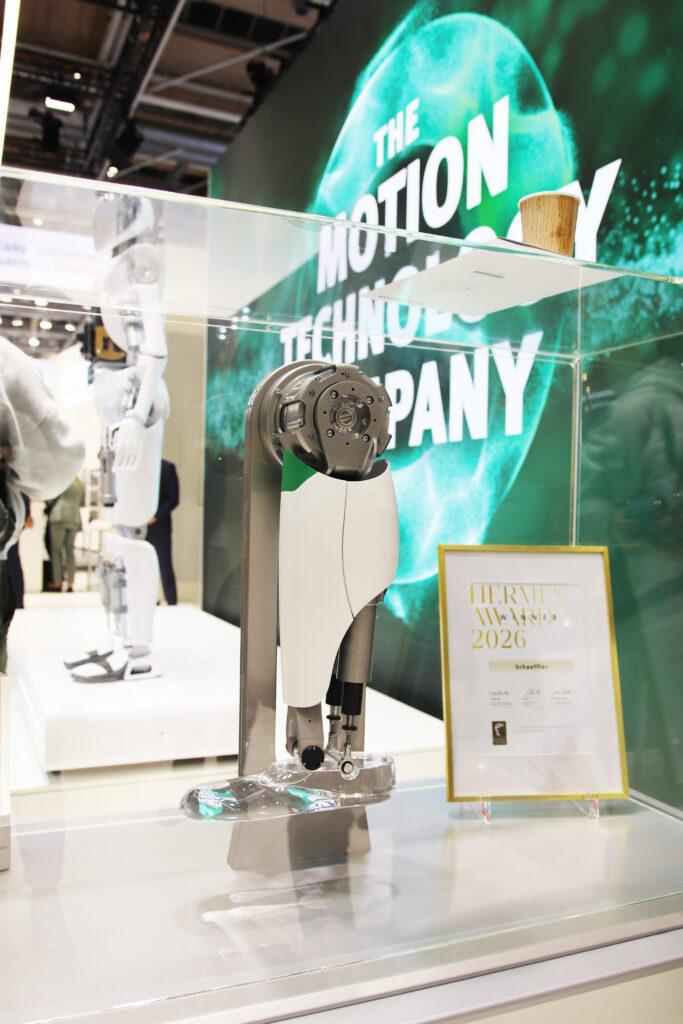
In his presentation, Technical Director Uwe Wagner emphasised that a humanoid robot is essentially a system defined by software and artificial intelligence. However, approximately half of its design is directly related to the execution of movement. This part primarily comprises actuators, which ensure the mechanical function of the individual joints. On this basis, Schaeffler has developed a modular actuator platform that covers various parts of the robot, from small joints at the wrists to high-load areas such as the knees or hips. It was precisely for this innovative approach and its contributions in the field of so-called Spartan actuators that the company received the prestigious Hermes Award 2026.
Design solutions and two principles of motion in detail
During the technical presentation, the actuators were divided into two main groups. The first consists of rotary actuators located directly within the joints, which enable bending and rotation. The second group consists of linear actuators operating on the principle of human muscle, i.e. shortening and lengthening, thereby setting the joint in motion via the corresponding kinematics. Both variants are based on the same foundation, which is a combination of an electric motor, a gear mechanism, sensors and control electronics.
A closer look at these solutions reveals a clear emphasis on integration and compactness. The electronics, including all sensors, are concentrated on a single printed circuit board, which reduces the space requirements in the axial direction by up to 10 millimetres. The electric motor, with its very dense winding and high copper fill factor, enables high thermal stability and performance to be achieved whilst maintaining minimal dimensions. The use of planetary gearboxes inspired by the automotive industry then contributes to the overall efficiency of the system whilst maintaining a smaller number of parts. The cabling is fully integrated within the actuator, so that only a single connector leads outwards for easy installation.
Two principles of motion
• Rotary actuators positioned directly within the joints provide bending and rotation.
• Linear actuators operate on the principle of human muscle.
Schaeffler in figures
and strategy (2025–2026)
» Revenue: €23.5 billion
» EBIT margin: 4%
» Free cash flow: €266 million
Strategy:
• Transformation into a Motion Technology Company
• Integration of Vitesco Technologies
• Strong focus on AI and digitalisation
Growth areas:
• humanoid robotics
• Defence industry
• Space technology
Global development:
» new robotics and innovation centre in China
» integration of development, production and data processing
Outlook:
• stable revenue
• improved margins
• e-mobility break-even around 2028
Open discussion: A behind-the-scenes look at development
The final part of the press conference was devoted to questions that shed light on the practical aspects of humanoid robotics. Uwe Wagner explained that the reason for testing robots internally in training centres is not just to collect data, but to obtain direct feedback from real-world use. This data is subsequently used to create digital twins, in which movements can be simulated and joint load requirements precisely defined. This gives the company a huge advantage in partnerships with other robot manufacturers.
Questions were also raised regarding the performance and endurance of these machines. Uwe Wagner clarified that humanoid robots are capable of performing tasks similar to those of humans, but their aim is not yet to surpass human strength. Energy consumption depends primarily on the battery, whilst Schaeffler is able to influence efficiency mainly through the design of energy-efficient motors. Current battery life is in the order of several hours, whilst the use of replaceable batteries for continuous operation is anticipated in the future.
The appearance of the robots themselves was also an interesting topic. According to experts at Schaeffler, it is not essential for a robot to look exactly like a human. What matters is functionality, particularly the ability to work with both hands, which is crucial for industrial applications. A robot’s movement can also be achieved using wheels if this is more efficient than walking in a given environment. The most important element remains intelligence and the ability to make autonomous decisions.
The entire Schaeffler exhibition presented itself as a well-conceived whole, guiding visitors seamlessly from bearings to a fully integrated system. It became clear that modern industry can no longer be viewed as a collection of separate technologies, but as an interconnected whole in which traditional engineering naturally complements digital tools.
A significant shift can be expected over the next two to three years, particularly thanks to the integration of physical robots with digital systems within the industrial metaverse.
Photo story from Hanover:
A journey into the heart of motion with Schaeffler
Hannover Messe 2026 is not just about the grand statements of CEOs. It is about the people who create and explain these technologies. Join us on a tour of the Schaeffler stand, where our guide Neelima and specialist Daniel took us from the very basics of mechanics to the future in the form of humanoids.