Eva Chvalkovská, Corporate Segment Specialist at Komerční banka, is an expert in ESG and sustainable finance. In an interview, she shared with us how the bank defines sustainable financing and what products, such as Green Loan, can support the business transformation towards a more responsible approach. We also discussed how the bank assesses environmental and social risks and what ESG trends it sees among its clients. The interview provides inspiring advice for companies on how to prepare for new opportunities and developments in sustainability.
How does the bank define sustainable finance and what role do products like Green Loan play in this?
Our bank follows a framework set by the entire Société Générale Group for sustainable finance, which has a sophisticated internal taxonomy for this area. This approach is called “Sustainable and Positive Impact Finance” (SPIF for short). It is a structure that clearly defines the criteria for financing projects with a positive impact on the environment or society. The aim of this approach is to ensure that the activities financed not only meet economic objectives but also contribute to long-term sustainability.
Sustainable financing includes, for example, investments in projects that have a positive environmental impact, such as reducingCO2 emissions, or projects with a positive social impact, such as education or health. It is this broader concept of positive impact that underpins our approach.
The products we offer include Green Loans and Sustainability-Linked Loans. Green Loans are loans that follow international standards known as the Green Loan Principles. These principles define what projects can be considered “green” and what requirements the financing must meet. For example, the client must demonstrate a clear environmental benefit of the project, for example through measurable parameters such as the amount ofCO2 emissions saved or an increase in the share of renewable energy.
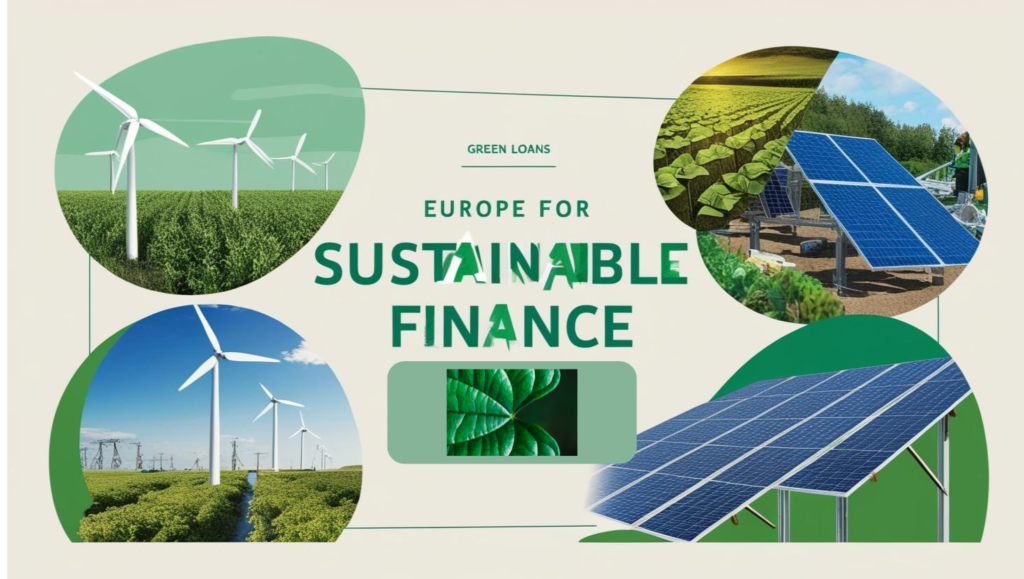
The approval process for Green Loans involves a thorough assessment and often a bit more reporting, which is why these products are not as common in the market. Nevertheless, they are particularly popular with clients who want to demonstrate their commitment to sustainability and contribute to decarbonisation. This commitment is important not only towards external partners, such as investors, but also internally towards employees or shareholders. In addition to the environmental benefits, sustainable finance helps clients better communicate their sustainability strategy.
How does the bank assess the environmental and social risks of the projects it finances?
We divide environmental and social risk assessment into two main areas. The first focuses on the client itself, i.e. its activities and approach to sustainability. We assess, for example, how it has set policies, whether it sets decarbonisation targets, measures its carbon footprint and whether it actually meets these targets or whether they are merely formal. We also look at how the client is addressing environmental risks, such as the impacts of climate change, and how it is performing socially. For clients with parts of their supply chain outside Europe, we look at whether there is a risk of forced labour or labour rights violations, for example. If such risks were to emerge, we also consider this to be a significant reputational risk and a breach of sustainability commitments.
The second area concerns the transaction itself, i.e. the specific project or investment to be financed by the bank. We look at what the environmental impact of the project will be, whether it will contribute to the reduction of emissions or the efficient use of natural resources. We have many of these principles embedded in specific sectoral policies. These apply, for example, to sectors such as oil extraction, energy production or even agriculture. In the sector policy on coal mining, we have stipulated that we no longer provide new financing to clients whose income from this activity exceeds 25% of turnover and who do not have a plan to exit the coal business. Based on SG Group’s commitment under the Climate Strategy, we are bound by the target to phase out financing to clients actively linked to the coal sector by 2030 at the latest.
If a client does not meet some of the requirements set out in the sector policy, we are in dialogue with them and seek to help them find a way to meet the criteria. For example, we can make funding conditional on them putting in place a new policy that meets our requirements and give them a specific timeframe to do so. Our priority is to help clients to be able to proceed with their projects in a more sustainable way.
Of course, the risks vary depending on the sector in which the client operates. We see the biggest challenges in sectors such as mining, cement and automotive, where emissions are naturally highest. However, companies in these sectors can be rated better if they demonstrate real action, for example by implementing a decarbonisation strategy or other sustainable measures. Our assessment is carried out using internal methodologies that include specific climate vulnerability indicators. These tools help us better understand where the client stands and what needs to be done to minimise risks.
What ESG trends are you seeing among the bank’s clients in the Czech Republic?
In the long term, there is a noticeable difference between large multinationals and smaller Czech companies. The former, especially if they are members of international groups, often take a proactive approach to ESG. They have issued sustainability reports before and their strategies are usually well developed and established. Smaller and medium-sized enterprises, especially local ones, take a more reactive approach to ESG. Their motivation was not as strong before, but this is changing with the upcoming reporting obligations under the new CSRD (Corporate Sustainability Reporting Directive) regulation, which started to apply to the largest number of companies from this year. Some companies have already started collecting data and preparing for the move, yet most are still waiting until the regulation forces them directly.
It is also interesting to see another group of companies that are not being pushed by reporting obligations but are facing pressure from their customers. Large corporations often demand carbon footprint calculations or decarbonisation certificates from their suppliers. For many companies, this is the impetus to start pursuing ESG.
What else do you offer clients?
In addition to financing, we offer other support to clients. We work with our consulting company ENVIROS Advisory, which helps clients not only with ESG reporting and setting up sustainability strategies, but also with preparing very concrete steps towards decarbonisation.
In addition, we also help with education. We organise regular ESG webinars, which are available free of charge, or we cooperate with the information website “Together Sustainably”, which we recently handed over as our original project to CIRA Advisory, which is developing it further.

Another of our activities is also beneficial for industrial companies – Komerční banka participated in the establishment of the Alliance for a Carbon-Free Future. This platform is aimed at companies with aCO2 emissions burden and helps them to find concrete solutions and inspiration on how to decarbonise their business. For example, we discuss here the possibilities of PPA contracts or other measures to promote renewable energy. Our aim is to bring industry and government together to work together towards a more sustainable future.
Which alternative energy sources do you think have the greatest potential for development in the Czech Republic?
Our experience and data clearly show that photovoltaics has the greatest potential. Every year it becomes one of the most common reasons for the investment loans we provide. About 40% of all investment loans where we know the specific purpose are related to renewable energy. In addition to the actual construction of solar parks, this also includes investments in the production of components needed for photovoltaics.
Another area with potential is wind power, but we are facing long permitting processes, which is still a major obstacle to its wider deployment. If these administrative hurdles can be removed or simplified, wind energy could be another key player in the development of renewable energy in the Czech Republic.
We also see growing interest in heat pumps, particularly in the context of investment in complex energy solutions by companies. Heat pumps are often part of broader projects to improve energy efficiency and decarbonise operations.
We also see great potential in the concept of PPA contracts, where companies enter into long-term agreements to purchase energy directly from renewable sources, often without the need for their own initial investment. This model may be particularly attractive for industrial companies that want to reduce their carbon footprint without having to invest heavily in their own infrastructure right away. Similarly, EPC contracts offer turnkey energy solutions, again with little or no investment cost to the client.
How do ESG criteria translate into financing decisions for companies in different sectors?
ESG criteria play an important role in financing decisions as they help us not only to assess the environmental and social benefits of projects, but also to minimise the risks associated with their implementation. As I mentioned earlier, we use specific indicators that assess how a company is doing in terms of sustainability. What is important is not only what sector it operates in, but also what specific steps it is taking to improve its ESG profile. For example, companies in higher-emitting sectors such as heavy industry or energy can be rated more positively if they have a clear and credible decarbonisation strategy.
In addition, projects that meet the ESG criteria have the opportunity to receive preferential financing terms. For example, for loans for photovoltaics or total renovation of buildings that will lead to greater energy efficiency, we offer clients more favourable interest rates. However, this always depends on the individual assessment of the client, their risk profile, profitability and other factors. Our goal is to motivate companies to make sustainable investments without compromising the sound economic basis for financing.
What challenges do you see in implementing ESG principles in the financial sector and with clients?
There are many challenges in implementing ESG principles, both for banks and clients. The financial sector is a major driver of change, which means that we are subject to all the regulations and obligations associated with ESG, including requirements from the European Central Bank. We need to translate these requirements into all our processes, which is a complex and challenging task. However, banks are well prepared for this and are leading the way on the topic of sustainability in society.
One of the biggest challenges is data collection. We need information from clients on their environmental, social and governance aspects, which is not always easy. The data needs to be detailed, up-to-date and accurate, and obtaining it requires the involvement of multiple departments within companies – from HR to manufacturing to operations or compliance. For many clients, this is a new experience that requires coordination across the entire company.
Another important point is training within the bank. ESG principles affect all parts of the organization, from salespeople to the back office. It is essential that every employee understands what ESG means and why it is important to implement it. This includes not only training, but also changing the approach to certain processes.
For companies themselves, implementing ESG is a similar challenge. Obligations such as CSRD reporting are complex and take time to understand and implement. For many companies, it is a step into an unfamiliar environment that requires time and coordination. It is often the first experience with this scale of data collection and analysis.
How does the bank assist its clients in implementing ESG principles?
We are ready to fully support our clients in this area and we know that implementing ESG principles can be a challenging process. We understand that the data and information we need from clients may not be completely accurate or complete on the first try. That’s why we work with them in stages and offer various forms of support, from consulting to specific tools and programs.
One of our main supports is ENVIROS Advisory, which focuses on the areas of ESG strategy, reporting and, above all, decarbonisation. It assists companies with the design of specific measures and their implementation, including the use of subsidy sources. It is therefore not only about proposing solutions, but also about securing the necessary funding.
One of the very useful programmes we have launched is ELENA. This programme works in partnership with the European Investment Bank and allows clients to recover up to 90% of the cost of consultancy. This means that the client pays only 10% and has a project ready to implement energy-saving measures, including the possibility of subsequent financing and subsidies.
We have also developed a digital carbon footprint calculator for smaller and medium-sized companies in cooperation with Impact Metrics, a Czech company. This platform allows companies to quickly and easily calculate their carbon footprint, including more complex categories such as Scope 3.
Our aim is to make the implementation of ESG principles not an insurmountable obstacle for companies, but instead a process that helps them improve their operations and relationships with partners. For example, we have greatly simplified the calculation of the carbon footprint, which is often considered challenging, with these tools. In addition, it allows companies to better respond to customer or regulatory requirements.
Source